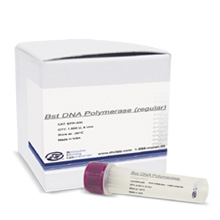
Bst DNA Polymerase (regular)
$0.00 – $543.84
| SKU | OPTIONS | Price | Quantity | ||
|---|---|---|---|---|---|
| BPR-200 | 8,000 units, 8 U/µl | $135.96 | |||
| BPR-205 | 20,000 units, 8 U/µl | $271.92 | |||
| BPR-210 | 50,000 units, 8 U/µl | $543.84 | |||
| BPR-OEM | Any Size | Please inquire |

- Description
- Additional information
- Documents
- Q&A
Description
Description:
rBst DNA Polymerase is a product of DNA pol gene of the thermophilic bacterium Bacillus stearothermophilus (Bst). The enzyme contains 5´ -> 3´ polymerase activity, but lacks the 3´ -> 5´ exonuclease activity. It also has an optimal activity at 65°C and can be used to synthesize DNA in regions containing template secondary structure or high GCs where other non-thermostable DNA polymerases may fail in sequencing. Therefore, rBst DNA Polymerase is useful in replicating difficult templates in various applications.
Applications:
- Isothermal DNA amplification by the method of:
· loop-mediated isothermal amplification (LAMP)
· whole genome amplification (WGA)
· ramification amplification (RAM)
- Random-primed DNA labeling
- Labeling by fill-in 5′-overhangs of dsDNA
Source:
An E. coli strain that contains the gene from Bacillus stearothermophilus.
Supplied in:
10 mM Tris-HCl
50 mM KCl
1.0 mM DTT
0.1 mM EDTA
0.1% Triton X-100
50% Glycerol
pH 7.5 @ 25°C
Supplied with:
10X PCR buffer II
10x PCR Buffer ll:
200 mM Tris-HCl
100 mM Ammonium Sulfate
100 mM KCl
20 mM MgSO4
1.0% Triton X-100
pH 8.8 @ 25°C
Unit Definition:
1 unit is defined as the amount of polymerase required to convert 10 nmol of dNTPs into acid insoluble material in 30 minutes at 65°C.
Recommended Storage Condition: -20°C
Reference:
Kiefer, et al. Structure 15 January 1997. 5, 95-108.
Additional information
| OPTIONS | 8,000 units, 8 U/µl, 20,000 units, 8 U/µl, 50,000 units, 8 U/µl, Any Size |
|---|
Manual & Protocols
COA ( Certificate of Analysis )
MSDS & Certificates
1. Does Bst DNA Polymerase have a 3′->5′ proofreading exonuclease activity?
No.
2.What is the difference between Bst DNA Polymerase (regular) and Bst DNA Polymerase, large fragment?
Bst DNA Polymerase, large fragment does not have the N-terminal exonuclease domain, so it not only lacks 3′->5′ exonuclease activity, it also lacks 5′->3′ exonuclease activity.
3. What is the best temperature range for Bst DNA Polymerase to be used?
The best temperature range is 60-65°C, it has 100% activity. The enzyme also has activity
4. What are the benefits of choosing Bst DNA Polymerase?
Bst DNA Polymerase, either regular or large fragment, is good at strand displacement with optimal temperature of 60-65°. This gives researchers a wider range of reaction conditions to optimize strand displacement and primer annealing. This is useful in the design of sequencing strategies as well as isothermal amplification technologies. The elevated reaction temperature facilitates sequencing through GC rich regions.
5. Can Bst DNA Polymerase be used for thermal cycle sequencing?
No, the reaction temperatures are too high for enzyme stability. It becomes inactive at 80°C for 10 minutes