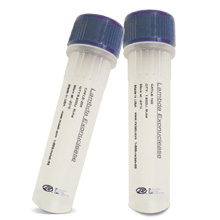
Lambda Exonuclease

$0.00 – $455.47
| SKU | OPTIONS | Price | Quantity | ||
|---|---|---|---|---|---|
| LE-100 | 5,000 units (20,000 U/ml) | $151.82 | |||
| LE-200 | 20,000 units (20,000 U/ml) | $455.47 | |||
| LE-OEM | Any Size | Please inquire |

- Description
- Additional information
- Documents
- Q&A
Description
Description:
Lambda Exonuclease is a highly processive exonuclease which selectively degrades the 5′-phosphorylated strand of double-stranded DNA via the stepwise 5′ to 3′ release of mononucleotides from duplex DNA. Lambda Exonuclease is inactive against 5′-hydroxyl termini(1), and does not initiate excision at a nick or gap(2), though it degrades a 5′-overhanging tail from duplex DNA at a greatly reduced rate.
Specific Activity: 100,000 U/mg
Application:
Catalyzes the removal of 5′-mononucleotides from duplex DNA.
Source:
Purified from a strain of E. coli that overexpresses the exonuclease gene from bacteriophage Lambda.
Supplied in:
25 mM Tris-HCl
50 mM NaCl
1.0 mM DTT
0.1% mM EDTA
50% Glycerol
pH 7.5 @ 25°C
Supplied with:
10x Lambda Exo Reaction Buffer
10x Lambda Exo Reaction Buffer:
670 mM Glycine
25 mM MgCl2
500 μg/ml BSA
pH 9.4 @ 25°C
Unit Definition:
One unit is defined as the amount of enzyme required to produce 10 nmol of acid-soluble deoxyribonucleotide from double-stranded substrates in 30 minutes at 37°C.
Recommended Storage Condition: -20°C
References:
1. Ausubel, F. M.,et al. (1987) Current Protocols in Molecular Biology (John Wiley and Sons, Inc.)
2. Little, J.W. (1981) Gene Amp. Anal., 2, 135-145
Additional information
| OPTIONS | 5,000 units (20,000 U/ml), 20,000 units (20,000 U/ml), Any Size |
|---|
Manual & Protocols
COA ( Certificate of Analysis )
MSDS & Certificates
The Q&A for this product will be available soon.