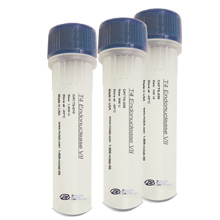
T4 DNA Polymerase

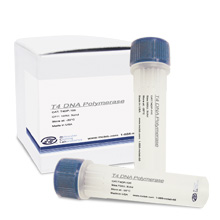
T4 DNA Polymerase
Description

A template dependent enzyme with 5 -> 3 polymerase activity and 3 -> 5 exonuclease activity
           
MSDS          
MSDS          
 
Name Cat# Size Concentration Price Qty
T4 DNA Polymerase
T4DP-100
3,000 units
3,000 U/ml
$150.00
T4 DNA Polymerase
T4DP-200
6,000 units
3,000 U/ml
$250.00
T4 DNA Polymerase
T4DP-300
9,000 units
3,000 U/ml
$400.00
T4 DNA Polymerase
T4DP-OEM
Any Size
N/A

Description:
T4 DNA Polymerase catalyzes the extension of a primed DNA template in the 5′→ 3′ direction. This enzyme exhibits a powerful 3′→ 5′ exonuclease activity, while lacking any inherent 5′→ 3′ exonuclease or strand displacement functions.

Specific Activity:
5,555U/mg

Applications:
  • 3´ overhang removal to form blunt ends
  • 5´overhang fill-in to form blunt ends
  • Single strand deletion subcloning
  • Second strand synthesis in site-directed mutagenesis
  • Probe labeling using replacement synthesis

Source:
Purified from a strain of E. coli that expresses the recombinant T4 DNA Polymerase gene.

Supplied in:
100 mM KPO4
1.0 mM dithiothreitol
0.1 mM EDTA
50% glycerol
pH 6.5 @ 25°C

Supplied With:
10X Blue Buffer

10X Blue Buffer:
500 mM NaCl
100 mM Tris-HCl
100 mM MgCl2
10 mM DTT
pH 7.9 @ 25°C

Unit Definition:
One unit is defined as the amount of enzyme that will incorporate 10 nmol of dNTP into acid-precipitable material in 30 minutes at 37°C.

Functional Tests

Single-Stranded Exonuclease Activity:
A 50 µL reaction containing 11,000 cpm of a radiolabeled single-stranded DNA substrate and 10 µL of enzyme solution incubated for 4 hours at 37°C resulted in greater than 80% release of TCA-soluble counts.

Double-Stranded Exonuclease Activity:
A 50 µL reaction containing 5,000 cpm of a radiolabeled double-stranded DNA substrate and 10 µL of enzyme solution incubated for 4 hours at 37°C resulted in greater than 50% release of TCA-soluble counts.

Nuclease Contamination Tests

Endonuclease Activity:
A 50 µL reaction containing 0.5 µg of pBR322 DNA and 10 µL of enzyme solution incubated for 4 hours at 37°C resulted in no visually discernible conversion to nicked circular DNA as determined by agarose gel electrophoresis.

E.coli 16S rDNA Contamination Test:
Replicate 5 µL samples of enzyme solution were denatured and screened in a TaqMan qPCR assay for the presence of contaminating E.coli genomic DNA using oligonucleotide primers corresponding to the 16S rRNA locus. The acceptance criterion for the test is the threshold cycle count (Ct) produced by the average of 3 replicate no template control samples. Based on the correlation between the no template control Ct values, and standard curve data, the detection limit of this assay is <10 copies genome/sample.

Quality Control Analysis

Unit Characterization Assay:
Unit activity was measured using a 2-fold serial dilution method. Dilutions of enzyme were made in 1X reaction buffer ([T4 DNA Polymerase]f = 0.25-0.002µg/µL) and added to 50 µL reactions containing 10µg denatured Calf Thymus DNA, 1X Blue Buffer, 4mCi/mL 3H-dTTP and 100 µM dNTPs. Reactions were incubated 10 minutes at 37°C, plunged on ice, and analyzed using the method of Sambrook and Russell (Molecular Cloning, v3, 2001, pp. A8.25-A8.26)

Protein Concentration (OD280) Measurement:
A 2.0 µL sample of enzyme was analyzed at OD280 using a Nanodrop ND-1000 spectrophotometer standardized using a 2.0 mg/ml BSA sample (Pierce Cat #23209) and blanked with product storage solution. The observed average measurement of 3 replicate samples was converted to mg/mL using an extinction coefficient of 128,440 and molecular weight of 103,609 Daltons. Acceptance for this assay is +/- 5% of reference sample.

SDS-Page (Physical Purity Assessment):
2.0 µL of enzyme solution was loaded on a denaturing 4-20% Tris-Glycine SDS-PAGE gel flanked by a broad-range MW marker and 2.0 µL of a 1:100 dilution of the sample. Following electrophoresis, the gel was stained and the samples compared to determine physical purity. The acceptance criteria for this test requires that the aggregate mass of contaminant bands in the concentrated sample do not exceed the mass of the protein of interest band in the dilute sample, confirming greater than 99% purity of the concentrated sample.

Recommended Storage Conditions:
 -20ºC  

References:

  1. Tabor, S. and Struhl, K. (1989) In DNA-Dependent DNA Polymerases. F. M. Ausebel, R. Brent, R. E. Kingston, D. D. Moore, J. G. Seidman, J. A. Smith and K. Struhl (Eds.), Current Protocols in Molecular Biology, pp. 3.5.10-3.5.12. 2. Sambrook, J., Fritsch, E.F. and Maniatis, T. (1989) Molecular Cloning: A Laboratory Manual, (2nd Ed.), 5.44-5.47.
  2. Dale, R., McClure, B. and Houchins, J. (1985) Plasmid, 13, 31-40.
  3. Kunkel, T.A., Roberts, J.D. and Zakour, R.A. (1987) R. Wu and L. Grossman (Eds.), Methods Enzymol., 154, pp. 367-382. San Diego: Academic Press.
  4. Panet, A., van de Sande, J.H., Loewen, P.C. and Khorana, H.G. (1973) Biochemistry, 12, 5045-5050.


: *
: *
: *
 
2X Universal Taq Master Mix
310 Capillaries
One-step Vector-based miRNA Target Screening Systems
2X Universal Taq Master Mix 310 Capillaries One-step Vector-based miRNA Target Screening Systems
$34.00
$180.00
$200.00

Product rating

Customer Reviews

There have been no reviews for this product.

Add your review here

: *
: *
Type the characters you see in the picture:


*